
We leverage the latest and most reliable technologies to build scalable, secure, and high-performance digital products.








“We wanted to streamline our local delivery operations with a custom app, and Genfura Technologies delivered exactly what we had in mind and more! From real-time order tracking to smart route management, seamless customer experience, and a powerful admin panel everything works smoothly. The app is fast, scalable, and easy for both customers and our delivery team to use.”

CEO
“Partnering with Genfura Technologies was a game-changer for our online store. From designing a sleek UI to integrating payment gateways, product management, and user-friendly dashboards they took care of everything with absolute professionalism. The team was super responsive, understood our business needs clearly, and delivered a scalable platform.”

CEO
“We came to Genfura Technologies with just an idea, we wanted to launch a local ride-hailing app. What we got in return was way more than we imagined. Their team built us a clean, easy-to-use, and fully scalable app that had everything live tracking, secure payments, and a solid admin dashboard. They were always there, quick to respond.”

CTO, Taxi App
“We approached Genfura Technologies for their Airbnb Clone Script and the experience was flawless. The platform was fully white-label, mobile-friendly, and packed with features like instant booking, calendar sync, and multilingual support. Within weeks, we had our own rental marketplace live tailored to our brand.”

CTO
No FAQs available for this page.
Fill in the details below to get started with our software. Experience our live demo today, instant launch capabilities, and free expert consultation.
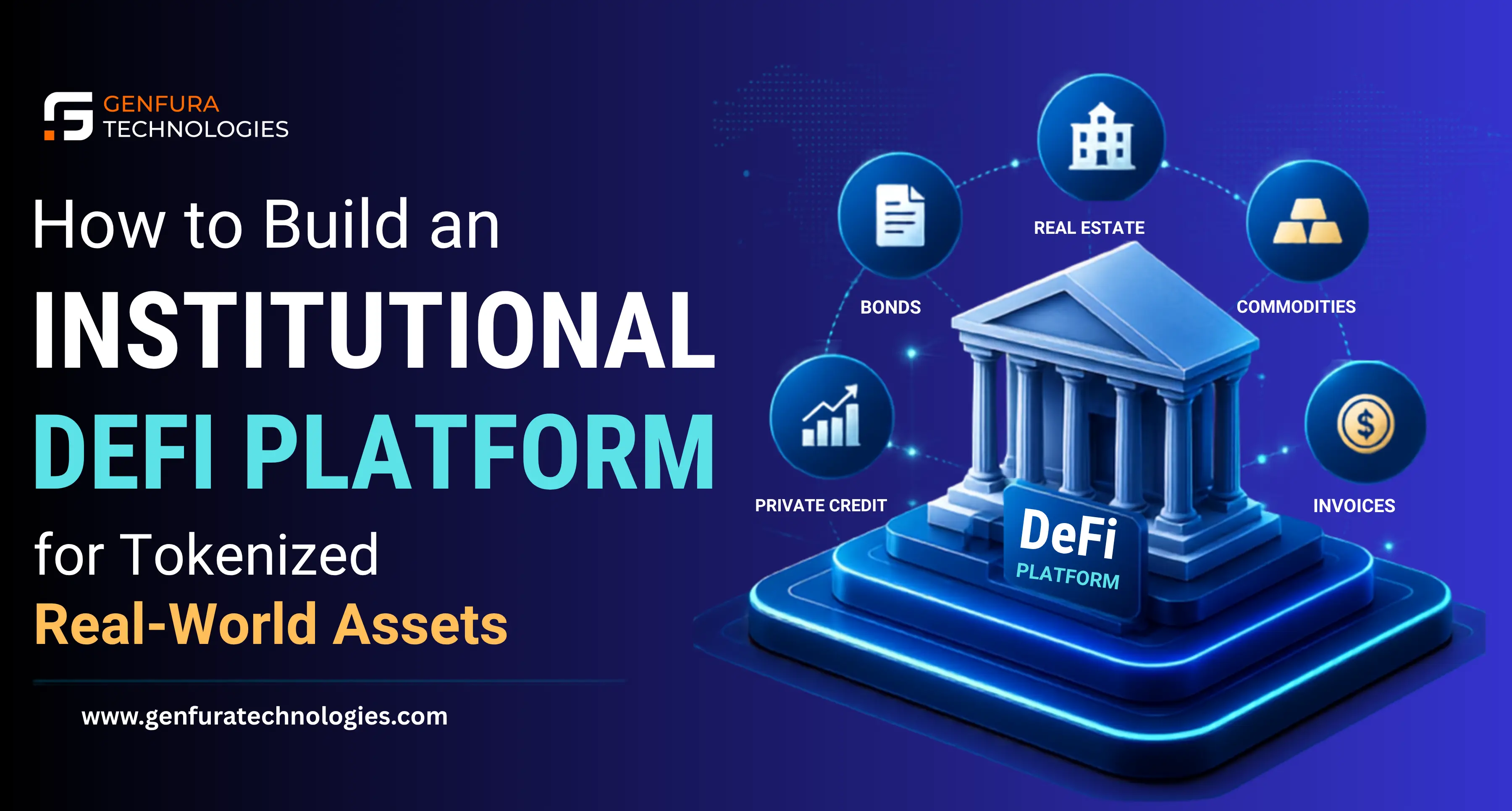
Tokenizing real-world assets is changing how financial assets can be issued, transferred, and managed on blockchain networks. But building an institutional DeFi platform around tokenized assets is very different from launching a basic DeFi application.
Banks, asset managers, fintech companies, investment firms, and RWA issuers need more than wallets and smart contracts. They need controlled access, regulatory workflows, asset verification, secure custody, transparent transactions, and infrastructure that can handle institutional requirements.
In this guide, I’ll break down how I would approach building an institutional DeFi platform for tokenized real-world assets, including the technology stack, essential features, compliance considerations, and development process.
The practical approach is to build the platform around five core layers:
The most important point is that institutional DeFi should be designed around the asset and regulatory model first, then the technology.
Start by deciding exactly what will be tokenized. It could be real estate interests, private credit, funds, invoices, commodities, or other financial assets.
The asset determines how the token should behave.
For example, a token representing a private credit position may require restricted transfers, investor eligibility checks, interest distribution, maturity management, and repayment tracking. A token representing a different asset may require an entirely different lifecycle.
Before development, define:
A robust platform typically combines on-chain and off-chain infrastructure.
The on-chain layer can manage token contracts, transaction settlement, collateral, and DeFi logic. The off-chain layer can handle identity verification, asset documentation, compliance records, pricing data, and business workflows.
For institutional users, I would also include:
This hybrid architecture provides flexibility without forcing every business process onto the blockchain.
The tokenization engine is the foundation of the platform. It should support controlled issuance, transfers, burning, redemption, and lifecycle events.
On top of that, a platform can introduce DeFi capabilities such as:
This is where choosing an experienced DeFi Development Company becomes important. The development team needs to understand both decentralized protocols and institutional financial workflows.
Compliance cannot be added at the end.
Institutional platforms may need KYC/KYB, AML controls, sanctions screening, transaction monitoring, investor restrictions, and jurisdiction-specific transfer rules depending on the asset and operating model.
Security should be equally systematic. Smart contracts should undergo rigorous testing and independent auditing, while administrative systems should use strong access controls and transaction approval mechanisms.
I recommend launching in controlled stages rather than exposing the entire platform immediately.
A practical development process is:
After launch, performance, liquidity, smart contract activity, and user behavior should be monitored continuously.
Building an institutional DeFi platform for tokenized real-world assets is not simply a matter of putting traditional assets on a blockchain. The platform needs to connect asset tokenization, institutional-grade security, compliance, identity, custody, and DeFi functionality into one coherent infrastructure.
If you're planning an RWA or institutional DeFi product, working with a specialized DeFi Development Company can help turn the business model into a technically and operationally practical platform.
It is a decentralized finance platform designed for professional financial participants, combining blockchain-based financial services with institutional requirements such as compliance, controlled access, security, and reporting.
Depending on the legal and regulatory structure, platforms can explore assets such as real estate interests, private credit, funds, commodities, invoices, and other financial or physical assets.
The requirements depend on the asset, jurisdiction, participants, and business structure. Institutional RWA platforms commonly incorporate identity verification, eligibility checks, sanctions screening, and transaction monitoring.
There is no universal choice. The right network depends on factors such as transaction requirements, smart contract capabilities, ecosystem integrations, privacy needs, interoperability, and regulatory considerations.
The timeline depends heavily on the asset model, compliance requirements, blockchain architecture, integrations, and DeFi features. A properly scoped MVP should be planned before estimating the full production timeline.
No comments submitted yet. Be the first to share your thoughts!